TL;DR
- Freehold: you own the property and the land. Leasehold: you own the property for a set term, while a freeholder owns the land.
- Most Lancashire houses are freehold. Most flats are leasehold.
- Leasehold means service charges and sometimes ground rent. Most new long leases since 30 June 2022 have a peppercorn (effectively zero) ground rent.
- Lease length drives resale and mortgages. Ask a solicitor to check your own lease.
You have found a flat you like, or you are about to sell one, and the listing says “leasehold”. What does that mean for your money and resale price?
Freehold means you own the property and the land it stands on. Leasehold means you own the property for a set number of years, while someone else owns the land.
Understanding leasehold vs freehold matters in Lancashire, where flats in Preston, Blackpool, Blackburn, Burnley, Lancaster, Chorley and Accrington are often leasehold. This guide covers ground rent, service charges, lease length and resale.
What Is Freehold?
Freehold is outright ownership of the property and the land, with no time limit. The owner maintains the building and land. There is no ground rent and normally no service charge, though some new estates have an estate charge, sometimes called “fleecehold”. Most Lancashire houses are sold freehold.
What Is a Leasehold?
Leasehold means you own the property for a fixed term set by the lease, which can originally run for decades or centuries, while the land belongs to the freeholder. The lease is a legal contract setting out ground rent, service charges and rules on alterations and subletting.
Most flats are leasehold because a shared building needs one owner responsible for the structure and common areas. Leasehold is not “renting”: you own the property for the term of the lease.
Leasehold vs Freehold at a Glance
Point | Freehold | Leasehold |
What you own | Property and land | Property only, for the lease term |
Ground rent | None | Usually payable |
Service charges | None (estate charges on some new estates) | Payable for shared areas and the building |
Maintenance | Your responsibility | Shared via the service charge |
Alterations | Generally your choice | Often needs the freeholder’s consent |
Resale | No lease length to worry about | Depends on years left on the lease |
The Pros and Cons of Leasehold and Freehold
Pros and Cons of Leasehold
- Plus: often cheaper than a freehold house, and the freeholder or agent arranges insurance and communal repairs.
- Minus: ground rent and service charges, lease rules on alterations, pets and subletting, and a lease that loses years and value over time.
Pros and Cons of Freehold
- Plus: full control, no ground rent and no lease running down.
- Minus: usually a higher price, and every repair is the owner’s cost and job to arrange.
Rights and Responsibilities: Who Looks After What
Who | Responsible for |
Freeholder or managing agent | Structure, roof, communal areas and buildings insurance, paid via the service charge |
Leaseholder | Inside their own flat, and keeping to the lease (consent may be needed for alterations; pets, flooring and subletting can be restricted) |
Freehold owner | Everything: structure, roof, insurance, drains and garden |
Why So Many Lancashire Flats Are Leasehold
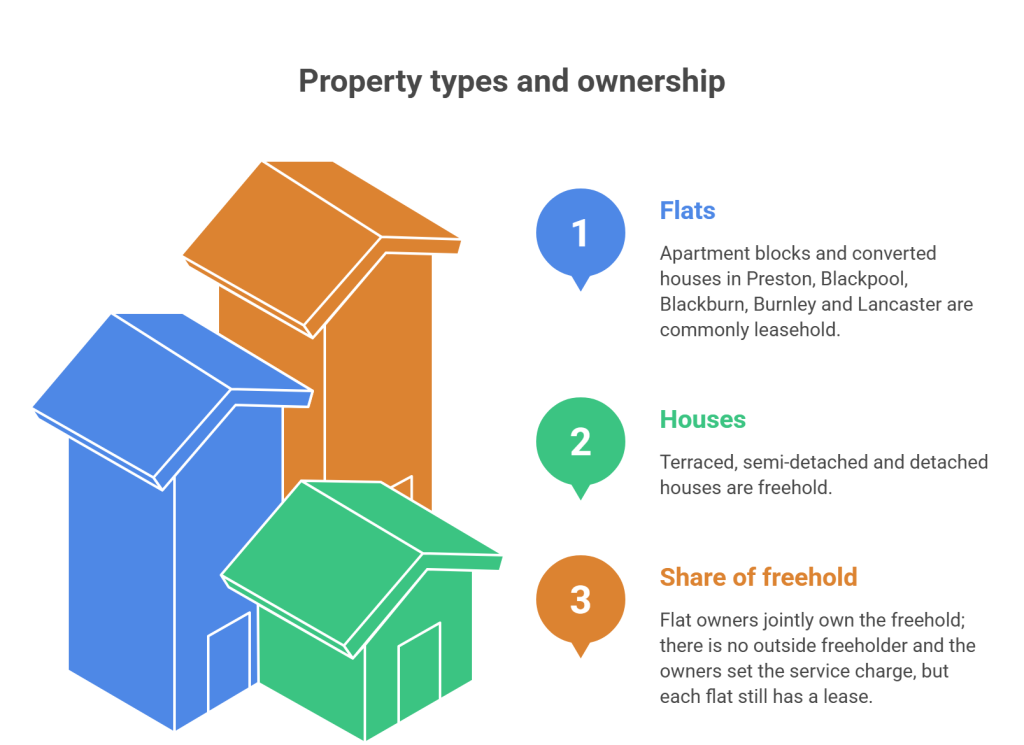
Apartment blocks and converted houses in Preston, Blackpool, Blackburn, Burnley and Lancaster are commonly leasehold, while terraced, semi-detached and detached houses are freehold. Shared roofs, hallways and grounds need a single owner or manager.
With a “share of freehold”, flat owners jointly own the freehold: there is no outside freeholder and the owners set the service charge, but each flat still has a lease.
Ground Rent Explained: What Leaseholders Actually Pay
Ground rent is a payment to the freeholder for the land the building stands on. The amount and any review clause are in the lease. A buyer’s solicitor should check for doubling or inflation-linked clauses, which can affect mortgages and resale.
For most new long residential leases granted since 30 June 2022, ground rent is capped at a peppercorn (effectively zero) under the Leasehold Reform (Ground Rent) Act 2022. Older leases can still carry ground rent, so check yours.
Service Charges and Management Companies
Service charges fund the shared running of the building, usually through a management company or managing agent. They typically cover:
- Buildings insurance
- Repairs to the roof, structure and shared areas
- Cleaning, lighting and upkeep of hallways and grounds
- The managing agent’s fee
Buyers should ask for the last three years of accounts and details of planned major works, because a big bill can follow you after completion. Sellers obtain a management pack (LPE1) from the freeholder or agent.
How Lease Length Affects Resale and Mortgages
A lease is a wasting asset: as the years left fall, value and buyer demand fall with it. These bands are general guidance, not rules:
Lease length | How buyers and lenders tend to see it |
99 years or more (especially 125+) | Generally comfortable |
Around 80 years | Extending usually costs more, because “marriage value” (the rise in a flat’s value once its lease is extended, part of which can go to the freeholder) can become payable |
Under 70 to 60 years | Many lenders and buyers become cautious, shrinking the buyer pool and price |
Sellers: A short lease is a common reason a sale sticks or falls through.
Buyers: Check the lease length before you offer, and use a short lease when you negotiate the price.
Buying a Leasehold Flat in Lancashire: A Checklist
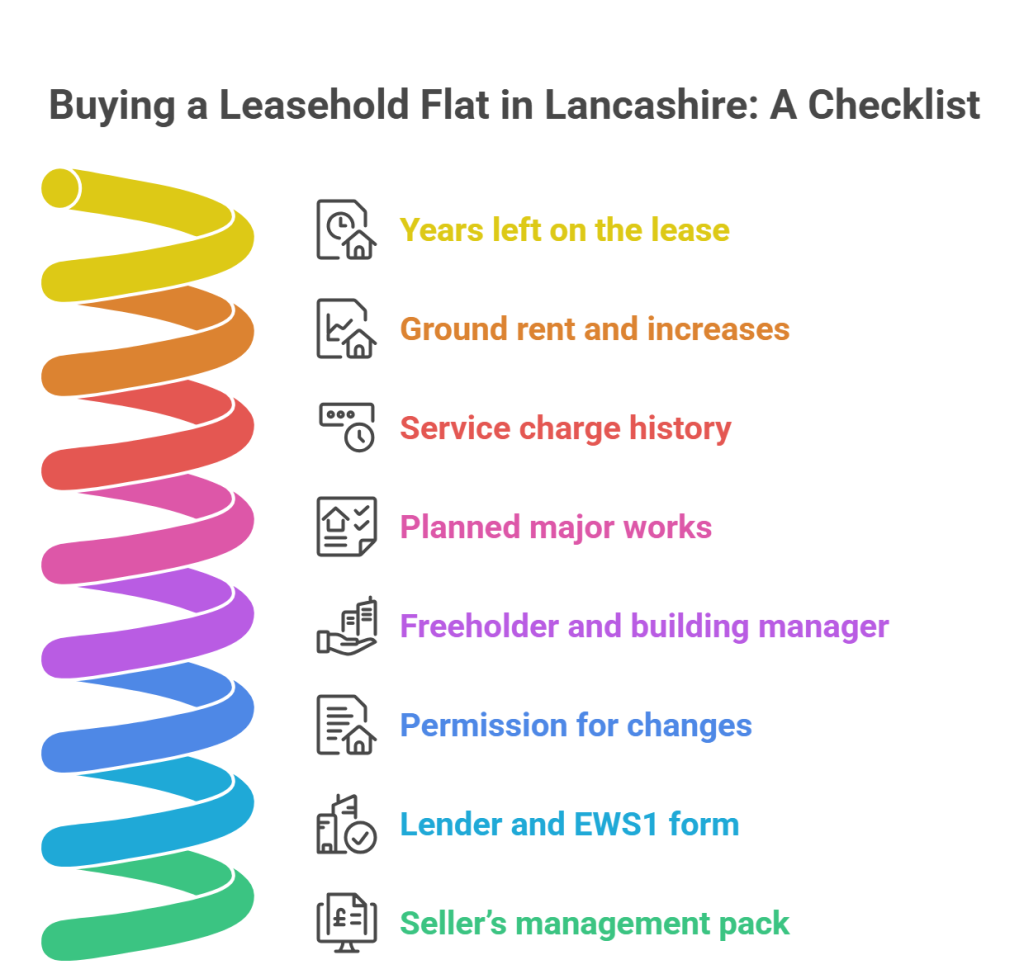
Before you offer, ask:
- How many years are left on the lease?
- What is the ground rent, and can it rise? How, and how often?
- What is the service charge, and what was it over the last three years?
- Are major works planned that I could be billed for?
- Who is the freeholder, and who manages the building?
- Do I need permission for alterations, pets or subletting?
- In a larger block, will my lender accept the EWS1 form or cladding position?
- Has the seller ordered the management pack (LPE1)?
See also our buying guide.
Selling a Leasehold Property: How to Protect Your Price
- Know your lease length before you list, and price honestly if it is short.
- Consider extending the lease. A longer lease generally widens the pool of buyers and lenders.
- Order the management pack early so legal delays do not hold up the chain.
- Have service charge accounts and insurance details ready.
- Be open about ground rent and charges. Late surprises often cause fall-throughs.
Can You Extend Your Lease or Buy the Freehold?
Lease extension: Most flat owners have a statutory right to extend, and the two-year ownership wait was removed on 31 January 2025. You will normally need a solicitor and a valuation surveyor.
Enfranchisement: Leaseholders in a block can often buy the freehold together, gaining control over charges and lease terms.
Right to Manage: Leaseholders can take over management without buying the freehold.
Rules are being reformed, so take advice before acting.
How Lease Extension Works, Step by Step
- Check you are eligible.
- Take valuation advice.
- Serve a formal notice through a solicitor.
- Agree the premium and terms.
- Complete and register the new lease.
Costs vary with the lease length and property value, so use a solicitor.
Leasehold Reform: What Has Changed and What Has Not
In force (November 2026): the Leasehold Reform (Ground Rent) Act 2022 caps ground rent at a peppercorn on most new long leases. The Leasehold and Freehold Reform Act 2024 removed the two-year ownership wait (31 January 2025) and changed Right to Manage rules (3 March 2025).
Not yet in force: most of the 2024 Act, including abolishing marriage value and banning new leasehold houses (with limited exceptions), still needs regulations. A draft Commonhold and Leasehold Reform Bill is not law.
Check the latest government position or ask a solicitor.
What About Commonholds?
Commonhold is a third tenure: owners own their flat outright and share the common parts through a commonhold association, with no lease running down. It remains rare in England and Wales.
Thinking of Selling a Flat or House in Lancashire?
Whether your property is leasehold or freehold, honest pricing and paperwork prepared early protect the sale.
Book a free, no-obligation valuation with Open House Lancashire, or speak to our local team about a short lease before you list. See our selling page or call 01282 786 060.
Freehold means owning the property and land outright. Leasehold means owning the property for the lease term while a freeholder owns the land, usually with ground rent and service charges.
Most flats are leasehold, including in Preston, Blackpool and Burnley, and most houses are freehold. Check your title and lease.
No. Ground rent is paid to a freeholder, so it does not apply to a normal freehold house.
Many buyers and lenders see 99 years or more as comfortable. This is guidance, not a rule, so ask your solicitor and lende
Extending usually costs more and buyers and lenders may grow cautious. Take advice early from a solicitor and a valuation surveyor.
It can, mainly where the lease is short or charges are unclear. A long lease, clear accounts and an early management pack help.